
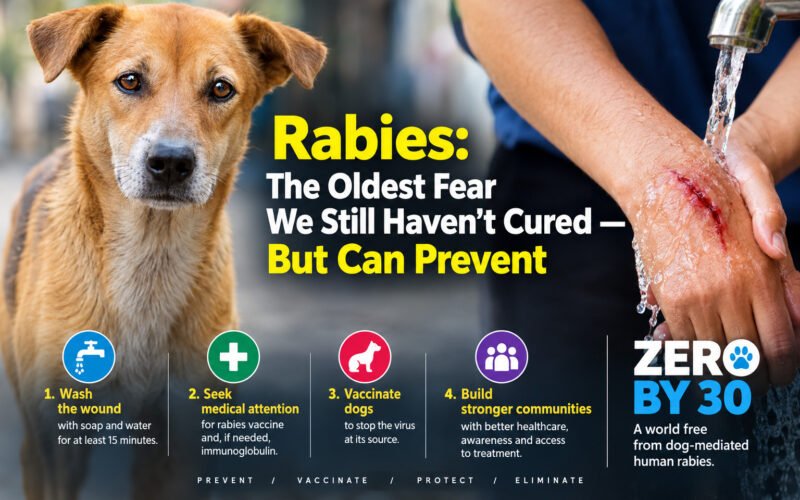
For thousands of years, humanity has feared a disease that can turn an ordinary animal bite into a race against time. That disease is rabies.
Rabies remains one of the world’s deadliest infectious diseases. Once clinical symptoms appear, the disease is fatal. Yet rabies deaths are preventable when people receive appropriate care promptly after exposure. Immediate and thorough wound washing, followed by timely rabies vaccination and, when indicated, rabies immunoglobulin, can prevent the virus from reaching the central nervous system.
That contrast makes rabies unusual: medicine has known how to prevent deaths from the disease for more than a century, yet people continue to die because prevention does not always reach them in time.
Rabies: A Disease Older Than Modern Medicine
Rabies is among the oldest diseases known to humanity. Ancient records contain descriptions consistent with rabies, long before scientists understood viruses or how infections spread.
For centuries, there was little effective treatment after a person was bitten by a rabid animal. Various methods, including cauterisation and traditional remedies, were attempted without reliably preventing the disease.
A major turning point came in 1885, when Louis Pasteur and his colleagues used an early rabies vaccine to treat Joseph Meister, a nine-year-old boy who had been severely bitten by a rabid dog.
That event became one of the landmark moments in the history of vaccination. It demonstrated that intervention after exposure could prevent a disease that was otherwise deadly.
More than a century later, rabies vaccines and post-exposure treatment are considerably safer and more effective. The challenge today is not simply knowing how to prevent rabies. It is ensuring that prevention reaches every person who needs it—quickly and affordably.
That makes rabies more than a medical problem. It is also a question of public awareness, healthcare access, animal vaccination, poverty and public-health infrastructure.
How a Dog Bite Can Become a Brain Infection
The rabies virus has a distinctive route through the body.
After entering through a bite, scratch or other exposure involving infected saliva, the virus can enter peripheral nerves near the site of infection and travel towards the central nervous system. The incubation period can vary considerably, which means a person may have no obvious symptoms for weeks or months.
That delay creates a critical opportunity for prevention.
Post-exposure prophylaxis (PEP) is designed to stop the virus before it reaches the central nervous system. According to the World Health Organization (WHO), PEP includes thorough wound washing, rabies vaccination and, when indicated, rabies immunoglobulin or monoclonal antibodies.
Once the virus reaches the nervous system and clinical symptoms develop, the situation changes dramatically.
What Are the Symptoms of Rabies?
The early symptoms of rabies can appear deceptively ordinary.
They may include:
- Fever
- Headache
- Weakness
- General discomfort
- Pain or unusual sensations around the bite or scratch
As the infection progresses, severe neurological symptoms can develop. These may include agitation, confusion, hallucinations, difficulty swallowing and paralysis.
One of the best-known manifestations is hydrophobia, commonly described as a fear of water. It is not simply a psychological fear. Attempts to swallow can trigger severe and painful spasms of the throat muscles.
According to the WHO, once rabies infects the central nervous system and clinical symptoms appear, it is fatal.
This is why rabies is fundamentally a race against time: treatment must begin before symptoms develop.
Dogs Remain at the Centre of Human Rabies
Rabies can infect many mammals, including dogs, cats, livestock and wildlife. However, dogs remain the main source of human rabies transmission globally.
The WHO says dog bites and scratches account for up to 99% of human rabies cases. This makes dog vaccination one of the most important tools for preventing human deaths.
Instead of focusing only on treating people after they are bitten, rabies-control programmes can prevent transmission at its source by vaccinating dogs.
The global burden remains substantial. The WHO estimates that rabies causes tens of thousands of deaths each year, with children under 15 accounting for about 40% of deaths. The disease disproportionately affects communities in Africa and Asia.
Why Rabies Is Also a Poverty Problem
The continued burden of rabies is closely connected to poverty and unequal access to healthcare.
In some communities, free-roaming and unvaccinated dogs are common, while veterinary services and large-scale dog-vaccination programmes may be limited.
For a person bitten in a remote village, reaching a healthcare facility may require travelling a considerable distance. The availability and affordability of rabies vaccines and rabies immunoglobulin can also vary.
The financial burden can extend beyond the cost of treatment. Families may have to pay for transportation and lose income while seeking medical care.
This means that rabies prevention cannot be separated from the question of healthcare accessibility.
Rabies in India: Why Prevention Matters
India carries a significant share of the global rabies burden, with dog-mediated transmission remaining a major public-health concern.
The country’s large population of free-roaming dogs, combined with differences in access to medical and veterinary services, makes rabies control a complex challenge.
Preventing human rabies therefore requires coordinated action involving healthcare professionals, veterinarians, local authorities, public-health agencies and communities.
The objective should not simply be to treat people after dog bites. It should also be to reduce the circulation of rabies virus among dogs through sustained vaccination, surveillance, responsible animal management and public education.
Zero by 30: Can Rabies Really Be Eliminated?
The global Zero by 30 strategy aims to end human deaths from dog-mediated rabies by 2030.
The approach combines mass dog vaccination, improved access to post-exposure prophylaxis, surveillance and community education. The WHO describes mass dog vaccination as a proven way to interrupt transmission at its source.
Recent developments show that elimination is achievable.
In September 2026, the WHO validated Bhutan’s elimination of dog-transmitted human rabies as a public-health problem, making it the first country in the WHO South-East Asia Region to achieve this milestone. Bhutan has recorded zero human deaths from dog-mediated rabies since June 2023.
Days later, Chile became the first country in South America to receive WHO validation for eliminating dog-transmitted rabies as a public-health problem. The achievement followed more than five decades without a human case of dog-transmitted rabies and decades of sustained vaccination, surveillance and access to post-exposure treatment.
These achievements do not mean rabies has disappeared globally. They demonstrate, however, that sustained public-health action can interrupt dog-mediated transmission.
What to Do After a Dog Bite or Scratch
One of the most important things to remember about rabies is that you should not wait for symptoms.
If you are bitten or scratched by a potentially rabid animal:
1. Wash the wound immediately
Wash and flush the wound thoroughly with soap and running water for at least 15 minutes.
If soap is unavailable, the WHO recommends extensive washing with water.
Wound washing is an important first step because it helps remove virus from the site of exposure.
2. Seek medical attention promptly
Do not wait to see whether the animal becomes sick.
A healthcare professional should assess the exposure and determine whether post-exposure prophylaxis is required.
Depending on the exposure category, treatment may involve a course of rabies vaccine and, for severe exposures when indicated, rabies immunoglobulin or other recommended products.
3. Do not assume a small wound is harmless
A bite or scratch does not have to look severe to represent a potential rabies exposure.
The decision about whether vaccination or other PEP is required should be made by a qualified healthcare professional based on the nature of the exposure.
4. Never wait for symptoms
This is perhaps the most important message.
Once clinical rabies develops, the disease is fatal. Prevention must therefore happen before symptoms begin.
Vaccinating Dogs Can Protect Entire Communities
Human rabies prevention does not begin at the hospital. It begins with controlling the disease in animals.
Mass vaccination of dogs is one of the most effective ways to interrupt rabies transmission. When vaccination coverage among dogs is sufficiently high, the virus has fewer opportunities to circulate.
Responsible pet ownership, dog vaccination, appropriate management of free-roaming dog populations, disease surveillance and public education are all important components of a comprehensive rabies-control programme.
A vaccinated dog is not only protected against rabies itself. Dog vaccination also helps reduce the risk to people and other animals in the surrounding community.
Rabies Is a One Health Problem
Rabies demonstrates why human health and animal health cannot always be treated as separate issues.
Doctors and other healthcare professionals diagnose and treat exposed people. Veterinarians work on animal vaccination, disease surveillance and animal-health programmes. Public-health authorities coordinate prevention and response. Communities contribute by reporting exposures, vaccinating pets and learning how to avoid animal bites.
This is the essence of the One Health approach.
No single profession or department can eliminate rabies alone. Effective control requires cooperation among medical professionals, veterinarians, public-health workers, local governments, animal-welfare organisations and communities.
The Science Exists. The Challenge Is Access.
Rabies presents medicine with a striking paradox.
The disease is almost invariably fatal once clinical symptoms appear, yet human deaths are preventable through interventions that have been available for decades.
The greatest challenge is therefore not a lack of scientific knowledge. It is ensuring that people have timely access to that knowledge, vaccines, wound care, veterinary services and post-exposure treatment.
The recent WHO validations of Bhutan and Chile show what sustained investment, surveillance, vaccination and cross-sector cooperation can achieve.
For an individual bitten by a potentially rabid animal, however, the lesson is much simpler.
Wash the wound immediately. Seek medical attention promptly. Do not wait for symptoms.
For communities, the lesson is broader: vaccinate dogs, strengthen surveillance, improve access to post-exposure treatment and educate people—especially children—about preventing animal bites and responding to exposures.
Rabies may be one of humanity’s oldest fears, but it does not have to remain one of our oldest killers.
The science is already available. The challenge is making prevention accessible to everyone who needs it.
Because with rabies, the treatment that saves a life is the one given before the disease reaches the brain.

Dr. A.Sundar
Assistant Professor, Department of Veterinary Public Health and Epidemiology, Veterinary College and Research Institute, Salem