
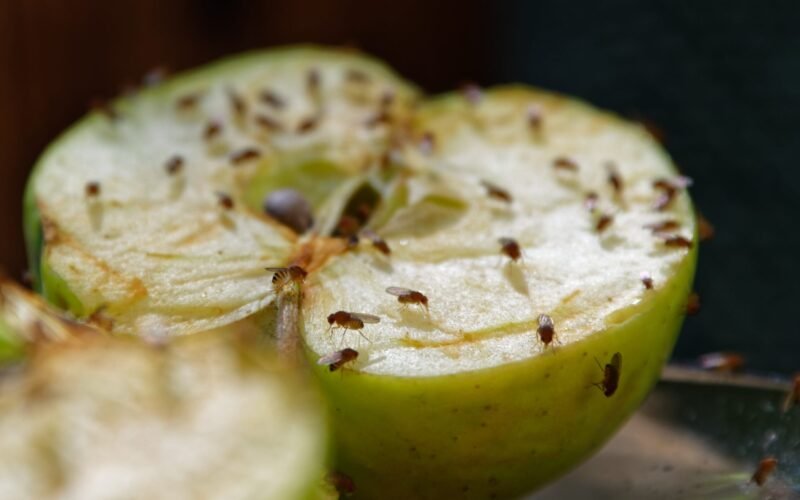
Fruit flies are destructive pests that infest a wide range of fruits and vegetables by feeding on their pulp. Their attack leads to fruit rot, oozing of brownish liquid, premature fruit drop, and heavy yield losses. If left unchecked, fruit flies can cause 20–40% yield loss, and in severe cases, damage may reach 90–100%, affecting both field crops and post-harvest produce.
Among the major species:
Bactrocera dorsalis mainly attacks mango and other fruit crops.
Bactrocera cucurbitae infests cucurbit crops such as bitter gourd, snake gourd, and other vine vegetables.
Effective management of fruit flies requires an Integrated Pest Management (IPM) approach combining cultural, mechanical, biological, and chemical methods.
Identification of Fruit Fly
Adult fly: Small orange to brownish-red coloured fly.
Maggot: White, legless larvae with a broad head, found inside the infested fruit.
Symptoms of Infestation
Brown patches and small puncture holes on the fruit surface
Oozing of foul-smelling liquid from infested fruits
Internal browning and rotting of fruit tissues
Presence of maggots tunnelling inside the fruit
Premature fruit drop before maturity
Neglecting early infestations can lead to severe crop losses.
Field Management Practices
Summer Ploughing
Plough the orchard interspaces during summer to expose fruit fly pupae to intense sunlight, which helps destroy them. Identify breeding sites, remove fallen fruits, and disinfect the area.
Early Preventive Action
In crops like drumstick and cucurbits (bitter gourd, snake gourd, etc.), fruits showing early holes or signs of ripening should be removed immediately. Fallen and infested fruits must be collected and buried in pits at least 60 cm deep to prevent further spread.
Pheromone Trap Management
Install Methyl Eugenol bait traps in shaded areas at a rate of 5–10 traps per acre.
Replace the lure every 15–30 days.
Adopt the Male Annihilation Technique (MAT) using:
0.1% Methyl Eugenol (1 ml/litre)
0.05% Malathion 50 EC (1 ml/litre)
Prepare the mixture in 250 ml wide-mouth bottles fitted with hanging devices.
This method is highly effective in reducing the male fruit fly population.
Natural and Mechanical Control Methods
Spray 3% Neem oil (30 ml/litre) to prevent egg laying by female flies.
Bag individual fruits with paper or polythene covers one month before ripening to avoid infestation.
Poison Bait and Chemical Control
Bait Spray
Mix Malathion 2 ml + Jaggery 10 g in 1 litre of water and spray at the base of the tree.
Alternatively, mix Methyl eugenol and malathion (1:1) and place 10 ml in polythene bags as poison traps at a rate of 25 traps per hectare.Alternative Poison Bait
Mix 100 g jaggery + 2 ml Deltamethrin 2.8 EC in 1 litre of water.
Spray on tree trunks, nearby hedges, and vegetation at weekly intervals.
Chemical Sprays
Spray Deltamethrin 0.025% three times at 15-day intervals, starting 45 days after fruit set.
Spraying Dimethoate 0.03% is effective up to two weeks before fruit harvest.

K.Ariputhiran, M.Sc. (Agri), Agricultural Officer, Biological Control Laboratory, Virudhunagar.